

By Sophie Lancaster
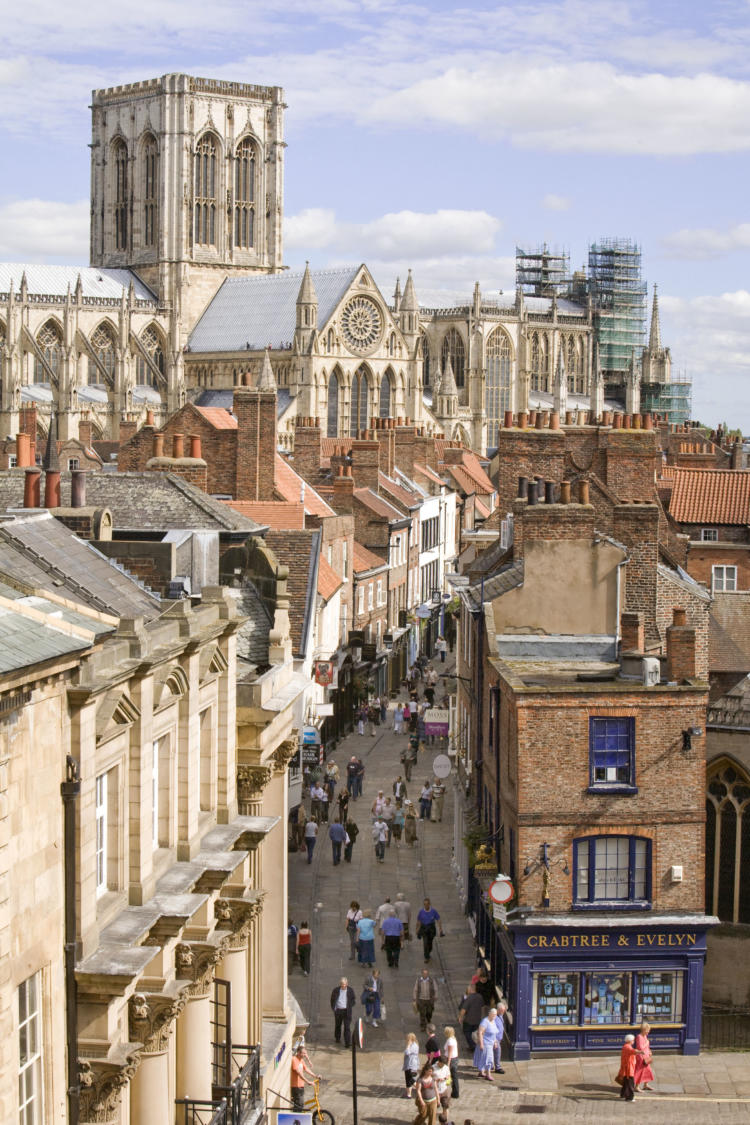
As one of York’s most historic streets, Stonegate is filled with history and brimming with buildings containing centuries of stories. This month, we’re going to explore just a couple of them…
But first, some background information on the street itself: Six feet below the cobbled pavement lies the original Roman road, Via Praetoria. The road connected the Roman headquarters to the river Ouse and the bridge crossing it. The name ‘Stonegate’ may come from the former use of this road – for taking limestone up to the Minster during its construction. The limestone, sourced from Tadcaster, would have been brought up from the river, down Stonegate and up to the Minster. This would have been the most direct route.
Due to how close it was to the Minster, Stonegate was populated by the wealthy and important citizens of York. The street was full of goldsmiths, printers, apothecaries, bookshops and more.
The Norman House
Located on Stonegate, between numbers 50 and 52, are the two remaining walls of York’s oldest home. It is the only remaining evidence of a medieval house in York, still in its original location. If you visit the Norman House, you can see the original stone walls and windows. The windows were found to be unglazed and would have had shutters too, which proves that it was in fact a domestic home.
Built between 1170 and 1780, it was constructed from stone, which was very expensive at the time, suggesting that its owner was someone of status in York. Buildings were normally built from wood, so this one would have been very grand and impressive.
The first records of the house start from 1376, when it was owned by a senior member of the Clergy. From the remains, it is thought that there would have been a large hall on the first floor for living in, and the ground floor would have been an undercroft. Undercrofts were used for the storage of valuable goods, and since they were made from stone, they offered great support for the rest of the building, as well as being fireproof. Sometimes, undercrofts were underground, like cellars, or were sometimes level with the street, used as workshops and places of trade.
The house was used by the Minster Clergy until the 19th Century, and rediscovered in 1939, later restored by the York Civic Trust in 1969.
Barley Hall
Barley Hall also has a long history on Stonegate. It was originally arranged to be built by the Prior of Nostell Priory, Thomas Dereford, in 1360.
The Priors would have attended different ceremonies and services at York Minster, and travelling from near Wakefield, it made sense for them to have a place to stay in York while they were here. The building was owned by the Priory until around 1430, when it was struggling financially. It was rented out privately to William Snawsell and his family, and they lived here for 20 years.
Snawsell was well known in York as a goldsmith, alderman (the equivalent to a town councillor today), and later the Lord Mayor of York.
When the dissolution happened during Henry VIII’s reign, the hall was confiscated from the Priory, and by the 17th Century it had been divided into several smaller residences.
It may have been during this time that the shortcut from Stonegate to Swinegate was first used by the public. Originally, it would have been used as a passage to transport food from the kitchens to the Great Hall.
Later, during the Victorian times, the hall was used as workshops by different tradesmen. This continued until 1984, when it became a plumber’s workshop and showroom.
The building was at risk of being demolished and made into offices, but was luckily bought by York Archaeological Trust in 1987. It has now been restored to look like it would have done during the time William Snawsell lived there.
No.33 Stonegate
Going back to how Stonegate was full of so many different trades, it was also known as the Street of Printers, famed as the home of a multitude of printers, booksellers and publishers over time.
It was during the 1500s that York got its first printing press. Along Stonegate, all the shops had wooden signposts hung outside, which showed what they were trading; the red devil above No.33 indicates that it was a printer.
The devil was closely associated with printers for a couple of reasons: The first is that, due to working with ink, printers would often have blackened fingers, and people thought that they were dabbling in the dark arts. The second was due to needing someone to blame – spelling and grammatical mistakes were common in print, and although these were down to human error, they were often blamed on the Printer’s Devil.
One of the best-known printers who worked at No.33 was Thomas Gent. Born in Dublin in 1693, he became a printer’s apprentice when he was 15. Unfortunately, his boss treated him harshly, which prompted him to move to London in 1710 to carry on his training. He received a letter from John White, a printer in York, who was looking for an apprentice and wanted Gent specifically.
John White owned No.33 Stonegate at the time. Thomas arrived in York to start work in 1714 and had travelled most of the way from London on foot, a journey that took him around six days. He worked here for a couple of years before going home to see his parents in Ireland, and then back to the printer he’d worked for before, in London. Thomas saved enough money to set up his own little press and moved back to York in 1724. He married a lady called Alice Guy, who had also worked for John White as a servant at No.33 during Thomas’ time there ten years earlier.
Alice was the widow of Charles Bourne, the grandson of John White. Charles had inherited his grandfather’s printing business, and when he died it passed to Alice. Once Alice and Thomas married, he took over the printing business at No.33.
From medieval homes to grand lodgings and printers, Stonegate has changed and seen lots of history over the centuries. The Norman House, Barley Hall and No.33 are just some of the stories from street. Next time you have a walk down there, see what other pieces of the past you can spot!


Add a comment