

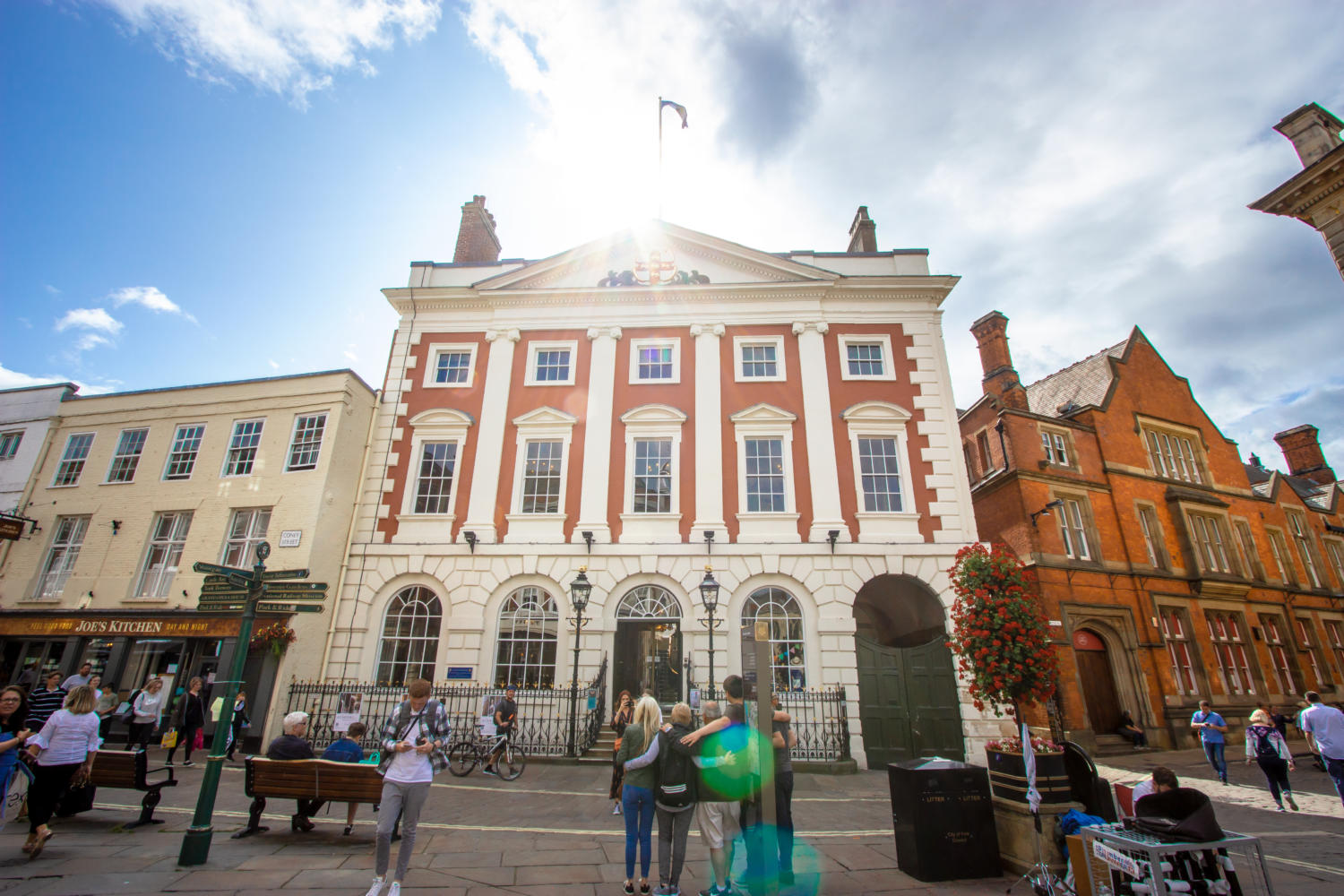

Did you know the place where York puts its annual Christmas tree is actually a former graveyard?
St Helen’s Square has been a gathering place for York locals for nearly three centuries, but it hasn’t always existed as the hotspot for buskers and protests we know today.
The oldest recorded history of the square dates back to it being used as a Roman Military fort. The Via Praetoria (the road which ran from the main gate facing the enemy to the headquarters) ran through modern-day Stonegate and towards the River Ouse. If you look closely, you can still see brass studs in the pavement outside the Ivy restaurant, marking the edge of where the fort used to stand, and it’s highly likely that Roman remains are still buried deep somewhere beneath the square.
The square later became occupied by the triangular graveyard of the nearby St Helen’s Church, from where the plot’s name originates. Limited records exist of what the land was used for in the Norman period, but the Church’s alignment indicates that it may have existed even before the Norman Conquest in 1066.
In 1725, construction began on the Mansion House, which sits directly opposite the church. Built specifically as the Lord Mayor’s working residence, a role it still serves to this day, the Mansion House also serves a new purpose as a visitor attraction. With cooking demonstrations held daily at 11:30am, tours of Mansion House are suitable for all ages, and have discounted rates for over-65s, students, and residents of York.
In 1745, a new burial ground in Davygate was given to the church, and the square was levelled and paved over to provide better access to Blake Street. Houses adjacent to this corner and facing the Mansion House were demolished in the late 18th century, and the rest of the south-east side was set back after 1900 to create the more rectangular shape we now know today – much to the distress of TripAdvisor critics, who point out the lack of an equal-sided, symmetrical layout.
Terry’s of York later set up its shop on St Helen’s Square in 1818, on what is now the site of the Impossible York restaurant and wonderbar, though the engraving on the stonework is still visible just above the stone columns.
So, as the winter months approach and we draw closer and closer to the beloved, beautiful festive displays that our city has become synonymous with, it’s worth remembering how many years of happy memories came before us to create the cultural hub we now take for granted.
Visit www.mansionhouseyork.com to find out more about the history of Mansion House or book a tour.


Add a comment