

By Tony Chalcraft
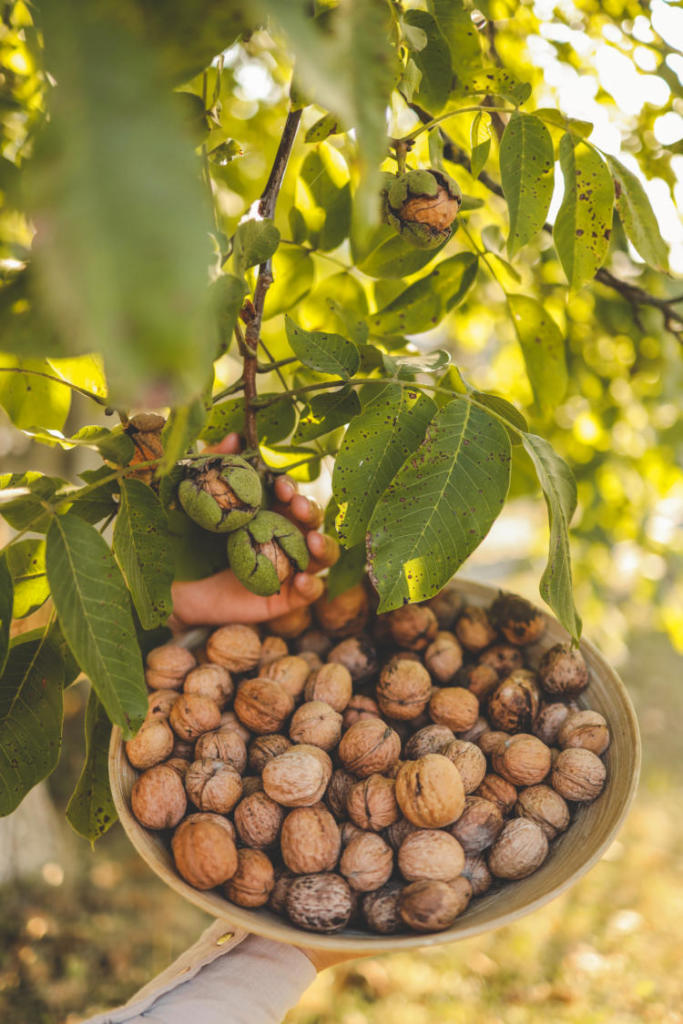
There aren’t a lot of nuts grown in the UK compared with many other countries. In our climate, only three trees will produce a useful harvest: hazel, walnut and sweet chestnut. Of these, just the hazel is commercially viable, and even this is cultivated on a very small scale, mainly in Kent, where a few farms still have traditional cobnut plantations or ‘nut platts’. There’s hardly any growing of walnuts and sweet chestnuts for market, although both can be foraged. In my Surrey childhood, collecting fallen sweet chestnuts from the woods was a regular autumn half-term activity. Here in York, sweet chestnuts don’t always reach a usable size. There aren’t that many trees either, but there are a few places around the city where clusters of trees shed enough chestnuts to make gathering worthwhile.
As the climate warms, other nuts, such as almond and pecan, may become viable in the UK. Growing interest in agroforestry (that’s integrating tree growing with ‘normal’ farm crops and livestock) may also give commercial nut cultivation a boost. Alongside this, there’s apparently been an uptick in interest in nut growing in gardens and small orchards. Specialist nurseries are selling more nut trees to amateur growers. Community orchards usually feature a nut tree or two, mostly hazels. Nut trees also fit into the permaculture system of growing, now very much in vogue. Some, it seems, are going nuts about nuts!
Plant breeding has certainly made it easier to grow nuts on a small scale through the development of dwarf walnut and chestnut trees. It’s now possible, for example, to buy walnuts that will grow, or so it is claimed, no higher than two to three metres and can be confined to a large pot. However, such trees require careful management to succeed, especially in the long term. Regular watering and feeding are essential, as is pruning to restrict growth. In reality, to thrive, nut trees and bushes, even the relatively compact-growing hazel, are best grown in the ground and given a good bit of room.
Lack of space though, isn’t the main reason why it’s best not to go nuts about nuts. In most situations, especially where there are lots of trees providing suitable habitat, nearly all the crop will be taken, usually well before ripeness, by animals and, to a lesser extent, birds. Grey squirrels are by far the most prolific plunderers, but mice and voles will steal hazels, as will some birds, mainly corvids like magpies. I’ve a few hazel bushes but never get a worthwhile nut haul. Squirrels and mice pillage the lot, the latter leaving telltale empty shells scattered beneath the bushes while the squirrels stash their loot in hidden larders for later eating. A neighbour’s walnut is similarly ransacked. I do know of a walnut tree owner who selectively coats nuts with diluted chilli powder using a sponge on a stick. Apparently, one bite of a chilli-daubed nut is enough to send squirrels scarpering.
Smearing nuts with chilli paste is a step too far for me. Using it on my hazels, with their much smaller nuts, is just not worth the effort. It’d be great if nuts were a viable crop in gardens with enough space to accommodate the trees, but the fact is that various critters, especially squirrels, make growing nuts for eating almost impossible. Unless exceptional efforts are made to fend off the nucivorous (the biological term for nut-eating animals, in case you’re wondering), you’re unlikely to see much of a crop.









Add a comment