

By Guy Dowse
Changing the habit of a lifetime is not easy. Indeed, there are those who will warn of the unforeseen consequences of so doing, but they are invariably members of the, ‘Don’t stand on the cracks in the pavement’, brigade, and you can’t let superstition stop you trying something new, can you?
Take Scarborough for example. I had always gone to the South Bay. My parents were not obvious crowd-followers; in fact, they would often walk to the far end of a train just to get away from people, but when they left the station, they would head down the hill to South Bay beach like everyone else.
Now, you could argue that most of what you associate with a seaside resort – cafes, shops selling memorabilia or items for the beach, a funfair, even a fishing quay – are concentrated in South Bay, but I’d certainly heard people sing the praises of the North Bay, and Peasholme Park – with its outdoor theatre, miniature railway and boating lake – is one of the town’s biggest tourist attractions.
Nevertheless, I might have remained South Bay-fixated till my dying day, had my partner not put her foot down recently and said we should explore more, and – given that we both love walking – we could easily do both bays in a day anyway. So, instead of coming out of the station and turning right as usual, we struck off across the road, past the Stephen Joseph Theatre and headed northwards.
After ten minutes of dull, nondescript streets, our way took us through a Victorian cemetery – a gothic township for the dead – replete with gravestone messages so overblown that a coach and horses rattling down the main avenue, bearing the undead Count Dracula in a coffin, would not have seemed out of place.
Yet, others were surprisingly prosaic and matter of fact and might have been written yesterday. “Look, Nick,” Emma called out as we browsed among the graves, “what a coincidence. I didn’t know Anne Bronte died in Scarborough. And I’ve never heard this name before—”
Here lie the mortal remains of John Patterson, born 1815, mariner and citizen of this town, who was lost at sea, October 5th, 1855. A close friend of the writer Acton Bell, better known as Anne Bronte of the parish of Haworth, who had a great love for the town and died at Wood’s Lodgings, Scarborough,1849.
“—I’d love to know more about their relationship.”
We must have been there for twenty minutes, absorbed as much in those obituaries which had withstood the test of time as in the beauty of the place. Then, when we continued, it seemed that one moment we were in the cemetery and the next in Peasholme Park because it was difficult to say where one ended and the other began, except that the path did a right and we were in a valley with a stream, heading down towards the sea, I imagined. Some parts were almost wild with tall trees and huge clumps of bamboo, others with little ornamental gardens with fountains and benches.
Eventually, we came out, via the boating lake and ornate main gates, onto the North Bay. The view was stunning, with the castle on its promontory at the end of a mile or more of beach; a mirror image of South Bay but largely devoid of people and human habitation. Round the seaward side of the promontory, connecting the bays ran Marine Drive, but that would be a hike and a half, and my eyes were already exploring the landward side, which revealed a path going up the slope and passing through an arch in the castle ramparts, presumably to South Bay.
We sauntered towards a distant flight of steps going from the beach up to the road, meanwhile enjoying the views, the sea air and a delicious breeze. When we arrived, however, what hadn’t been so obvious from where we had come was a permanent pool round the bottom of the steps left by the sea as it went out, making them inaccessible other than by clambering over huge rocks at their sides. These my partner – who is considerably younger than me – negotiated like a sure-footed mountain goat, but I was more challenged by the task, and (at risk of losing my balance) did much of it on all fours.
“Get your foot on the handrail,” a man’s voice said from the beach, “then lower yourself down from there.”
I glanced up. Where had he come from? I thought we had the beach to ourselves. A sunbeaten face. Wearing an old-fashioned black jacket, black corduroy trousers and a peaked cap which reminded me of something I’d seen a young Lennon wearing (or was it Dylan?).
I followed his instructions and lowered myself down the rather short (let’s be honest) concrete wall onto the steps in a very ungainly way. I thanked him with as good grace as I could summon. I would put him at about the same age as me but have to concede that he looked in far better physical condition.
“Are you from Scarborough?”
“From (he mentioned some village whose name I didn’t recognise) about five miles up the coast,” pointing over his shoulder.
“You’ve walked here!” Emma said, sounding impressed.
“I walk everywhere. Making up for lost time.”
We both looked at him quizzically.
“I was a ship’s captain, rarely on land—. And you—(to both of us) you’ve come from York?”
“How do you know. Is it so obvious?”
“A lot of visitors do come from York. Either they live there or come on the train from beyond.”
I pointed across the road to the path. “Will that take us to the South Bay?”
“Yes, go through the arch at the top, and the way down to the harbour is straightforward. If you’re interested, on your right as you go down is the church of St Mary’s, in the churchyard of which you’ll find the grave of the writer, Anne Bronte, who died in Scarborough—”
“—Oh, we’ve just seen a gravestone in the cemetery at the top of the park—,” Emma said in an animated voice, frowning as she struggled to point in the right direction, “er,—which referred to her and her love of Scarborough. Do you know—?”
“—Yes.” He smiled as if he had been anticipating the question.
“Are you going this way?” I pointed up the path.
“No, Marine Drive for me. I’m going to stick to the sea,” indicating along the road with the castle rock on one side and the sea on the other.
We shook hands. “Thank you for your help. I’m Nick, and this is my partner, Emma, by the way.”
“John—. Might see you on the other side.”
“Maybe,” I said to be polite, but it seemed unlikely.
He walked off at a brisk pace, and we crossed the road to the start of the path. I’m past the age when I could run up hills, so – while enjoying the climb for its own sake, with the smell of shrubs and trees in my nostrils and the ever-present tang of the sea, my attention was mainly on the path in front of me until we were about halfway up. Only then did I turn to take in the Bay and where we’d come from and – what we couldn’t see from below – the magnificent line of high cliffs stretching away northwards towards Robin Hood’s Bay, Whitby and Staithes, while the castle and ramparts above us pointed out to sea.
Our new acquaintance should be visible in a similar direction, but he’d already disappeared, and it must be a good half mile from where we’d left him to where he rounded the promontory. “Christ, he’s going at a fair old lick,” I muttered.
Anyway, he was soon forgotten as we climbed the last bit. At the top we stopped briefly to take in the vast emptiness of sea and sky (the land dwarfed into insignificance now) with the unearthly shrieks and wailings of gulls – like lost souls – in our ears.
With hindsight, part of the weirdness of the day was that the strangest and most unsettling things happened when you least expected them. So, for example, passing through the arch, we found ourselves in an altogether warmer, friendlier environment than the North Bay’s austere, stark beauty; even the castle seen from this side was less forbidding, and a green sward fell away to red-tiled roofs, with the harbour below that in the distance, crammed with gaily painted boats. And there on the right was the church, just as John had said it would be, and we located Anne Bronte’s grave easily enough.
But up close, it was in a terrible condition and much of the lettering had crumbled, though the name of the writer in an old font was still intact. “Poor Anne,” Emma remarked, “as if dying of consumption wasn’t enough.”
I don’t know why, but something inside urged me to touch it. Barely had my fingers made contact with the surface when – to my horror – a piece with the name ‘Anne’ on it broke off and landed upright, accusingly, on the stone surface of the grave.
“Oh my God, no!” My initial instinct was to grab it and put it in my rucksack pocket to hide my crime, even though I knew as well as Emma did what had just taken place. We stared at one another, concern written on both our faces.
“What are you planning to do with it?” she asked.
“I don’t know. Come on,” and started walking away quickly as if pursued by some guardian spirit.
She hung back. “You can’t just walk off.”
I turned. “What else do you suggest I do?”
“You could tell the police, leave the piece of stone with them and offer to meet the cost, whatever it is. They’ll recognise that you made an error of judgement, but that thereafter you acted in good faith.”
“It’s easy for you to say that, but it’s like a holy relic here in Scarborough. They could throw the book at me.”
“Nick, it’s not as big a deal as you’re making out. Either do as I’ve said or just leave it.”
“Someone else will come along and pocket it if it’s just lying there.”
“So, what are you going to do with it then?”
“Keep it.”
“Keep it? Even if you’re ok morally with that, you can hardly put it on display, can you? It’s incriminating, especially in the light of the furore the media will whip up.”
I didn’t feel comfortable. I knew she was right, but she hadn’t done it. If she had, she might have seen things differently. And simply chucking it in a litter bin – or as far as I could throw it – seemed an even worse option if I had any respect for the grave and its occupant.
We stood there staring at one another with the same perplexed expression on our faces, stuck in the same unnatural pose, like a pair of dummies in a shop window.
“Come on,” I repeated, and started walking off again. She dithered, then slowly followed, obviously not happy at all with the outcome.
I remember little of the way down, but we eventually arrived at the front by the harbour. I can’t speak for Emma, but I was in a daze. Any plans we might have had for the rest of the day – not least to have fish and chips somewhere – had gone out of the window.
As if that wasn’t enough, out of the blur of sights and sounds of a holiday resort I spotted our new acquaintance. We were walking along the front past the lifeboat station, and there he was, sitting on a railing on the beach side of the pavement. After the graveyard business, I had no desire to speak, but he had already seen us. In fact, it was as if he was waiting for us.
Anyway, I forced my face into the semblance of a smile, and the best thing to say I could think of to be both polite and make it obvious that we weren’t stopping was “—Small world!”
But, from the moment my eyes alighted on him, he was scowling at me, nor did he say anything as we walked past, a couple of feet away, which was totally unlike his manner in North Bay.
“Sorry?” Emma said, having heard me speak. Then, when I looked at her, I realised she hadn’t seen him. I don’t know how, but true nonetheless.
“Oh, er—just talking to myself.”
“You want to watch that!” she joked.
I made a poor attempt at matching her smile, but it must have been obvious that my head was a million miles away.
“Are we going to eat soon?” she asked.
“Er, yes. Right.”
In fact, the fish and chips were nice, and when we had eaten, we strolled along the water’s edge, with barely any breeze and the sea like a millpond. Gradually my equilibrium was being restored, and Emma seemed to have forgotten the inscription (which in turn made me feel better).
I got my mobile out to text my daughter. Emma was a few yards ahead. She turned and when she saw I was texting, removed her shoes, turned the bottoms of her jeans up and continued on, walking slowly through the shallows.
When I had finished, I put my mobile away, took my shoes off, rolled my jeans up and followed her, shoes and socks in hand.
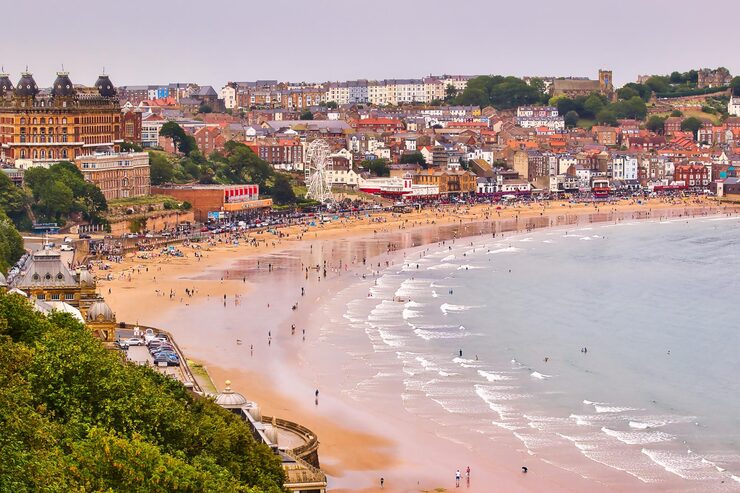
I stopped briefly and turned to take in the South Bay, with the backcloth of the castle occupying its rock so robustly and the Grand Hotel standing tall too, and in the foreground the gaudy reds and golds of amusement arcades in Foreshore Road, the clean, sea-blue and white facades of fish restaurants and the helter-skelter in the funfair beyond the harbour looking like a giant barber’s pole. Even the sea from this angle was a warm, Mediterranean aquamarine.
It was early evening by now, with very few people on the beach. I walked on, and Emma – about a hundred metres away – when she saw me start moving towards her, set off walking again.
I think it was looking ahead to where the old, open-air swimming pool used to be and remembering diving into its icy greyness as a teenager, that brought back the cold, emptiness of the North Bay as seen from the castle ramparts an hour before, and bits of the day so far that I’d prefer to forget, because I shivered and stepped out of the water.
I was suddenly aware of someone approaching from behind, but there had been no one near last time I looked. It was him. This time I would let him speak.
“What are your intentions, Sir?” he said.
“About what?—Just who are you?”
“I think you know the answer to both those questions.”
The trainers slipped from my grasp and fell onto the sand and I felt as if all the blood had been drained out of my body and I was suddenly turned to stone or become one of those metal figures on the Lancashire shore, placed there to be washed over by the sea to the end of time.
“Nick, what are you doing? Come on!” Emma shouted ahead.
I bent down to retrieve the trainers. When I stood up again, he had gone. I did a full turn, looking in all directions including the sea. He had disappeared completely.
My mind was reeling. Had I imagined what had just taken place? Surely not. I did another quick turn. No sign of him. Distant voices. One or two cars on Foreshore Road. The odd squawk of a gull. Nothing out of the ordinary.
I put my shoes and socks on and caught Emma up. “What were you doing? You look as if you’ve seen a ghost. Why did you keep turning round?”
“Oh, er—I was just taking in the sights—”
Yet again, she hadn’t seen him. Disturbing as what had happened was, her not knowing somehow seemed safer, though I couldn’t say why.
She put her sandals back on, leaning on me as she did so. “I’m going to put you on a lead and not let you out of my sight, you naughty boy.” She gave me a sloppy kiss. We smiled at each other and our foreheads touched, and my focus on the here and now returned.
“Ok. I promise to behave.”
“Right, here’s what I want to do: have an ice cream, get the cliff lift up to the top, then walk back to the station via the footbridge, past the Grand and through the town—.”
—A few minutes later, t
he carriage door of the lift crashed open, and a couple of people got out. We went in, clutching our tickets, the doors crashed to and this showpiece of Victorian technological ingenuity began its slow ascent up to the South Cliff Esplanade, while we admired the South Bay from an ever-changing perspective.
When we arrived, we turned right in the direction of the footbridge, the Grand Hotel and the town centre—. And, there he was again, sitting on the railings on the cliff edge with a beaming smile on his face.
Forewarned is forearmed, I thought, and on the basis of what had happened previously I presumed that she wouldn’t see him, and that it behoved me to act normally, not speak, and not behave as if I was having a seizure.
All of this came to naught, however, because she saw him at least as quickly as I did and grabbed my arm. “Look who it is, Nick—.
—Hello! Fancy seeing you here,” I felt obliged to say.
“It is a small world indeed,” as if in response – only now – to my comment by the lifeboat station before lunch. “This was a favourite spot of my late partner. We used to come here a lot. She fell in love with Scarborough.”
“Where was she from, Mr—er?”
“Patterson. Oh, a small village near Bradford—.” He smiled at her, then looked searchingly at me, but I was determined to say nothing. After a pause and smiling at Emma once more, “Well, very nice to meet you both again, but I must be going. I’m due somewhere else shortly. Good day to you both.” He lifted his cap briefly.
“Bye.”
“Bye.” I added, with relief. Thank God for that.
He took a flight of steps, zigzagging away down the side of the cliff lift until he was out of sight.
“What a nice man. How weird we should meet him here in such an out of the way place. I wonder what happened to his late partner. I didn’t like to ask. Poor man—!”
I was pretty sure I knew the answer, but I wasn’t going to say anything. By the time we got to the Grand we both needed the toilet desperately and decided to go in the hotel.
When I came out Emma was still inside. I noticed a blue plaque on the wall saying that Anne Bronte had died in 1849 in a house on the cliffs, precisely where the Grand was later built. I stared at the plaque for a lot longer than I needed to digest what was written there, lost in my thoughts.
“We loved each other deeply, but it wasn’t to be—.”
I knew who it was, but it still made me jump. He was very close, looking over my shoulder, so that when I turned, I was obliged to take a step backwards.
“—I survived the disease that carried her and most of her family off, but not a broken heart.”
“I’m sorry,” I said, unable to think of anything better to say.
“It won’t bring her back or mend my heart, but if you return something you have of hers, it will be a help.”
“What do you refer to?”
“Come, Sir. Don’t bandy words with me. Time is short. I promised Anne I would protect her for eternity. I was unable to achieve that in the world of the living, but I am determined not to be frustrated in the other.”
I turned to face the plaque once more. “But why is that thing you seek so important to you—?”
“Who are you talking to this time?”
I swung round. Emma was there, but no sign of him. To compound my crimes, I was shiftily looking up and down the street as if I had agreed to meet someone and they were late.
Nodding at the plaque, “I was thinking about Anne Bronte, and I got carried away—”
“I think you need carrying away from Scarborough, Nick. It seems to be having, a malign effect on you. Come on, let’s get the train back to York and go for a drink. I don’t trust you here. I don’t know what you might get up to.”
At least she was laughing as she said this. I wanted to say more, to try and account for my behaviour in some way, but going back to York seemed a good alternative.
When we got to the station, there was a train leaving almost immediately. A couple of minutes before it was due to leave, I was checking the gallery on my mobile just in case there were any pics of our friend (nothing!). Suddenly, Emma is elbowing me, with a big smile on her face and waving at someone on the platform.
“Look, Nick, it’s nice old Mr Patterson.”
Nice old Mr Patterson was smiling and waving back at her politely, but it was me he was more interested in. He pointed at the top window. I knew what he wanted.
I opened it. The whistle sounded.
“Come, Mr Armstrong—,” (How on earth did he know my name? I hadn’t told him.) “—stop playing games. You can’t run forever. If you don’t give me what I seek, I will be waiting for you in York.”
I reached inside my bag and located the piece of gravestone with the name on it and passed it to him through the window.
He took it and nodded his head. “Thank you.” He touched the peak of his cap at Emma. “Ma’am.”
The train started moving. Emma waved again as he disappeared from view.
“What was that all about? What did he want with you? What did you give him?”
I looked at her. How could I explain? What had happened must seem strange, but there was still a perfectly logical explanation from her standpoint.
“I’ll explain when we get back to York.”
She looked at me searchingly, with her eyes screwed up, as much as to say, ‘I know you’re not telling me everything, but I’m not going to get anything more out of you at this moment, am I?’. Then, with a shake of the head, she turned away to look out of the window as we pulled out of Scarborough.
It was a beautiful mid-evening when we got back to York. The Minster looked a picture with the last rays of the sun falling on it as the train clanked over Scarborough Bridge. The station concourse was packed, mostly with people dressed like extras from some nineteenth century drama, and we had to virtually push our way through the crowd.
“God! If it’s not Romans or Morris dancers, it’s a bloody Gentleman Jack weekend—”
“—Stop wittering, Nick! Be thankful you live in York.”
In fact, after what had taken place in Scarborough, she might have a point—. If only she knew. However, we were barely in the foyer, where the taxi rank is, when a voice that had become increasingly familiar hailed me from behind. “Mr Armstrong!”
I turned, as did Emma. She had heard him too.
He was standing next to the wall, by the automatic doors. At his side with her arm through his was a tall woman dressed all in black and in a similar style to any number of the women dotted around the station. They moved towards us once they had attracted our attention.
“Hello again,” said Emma. “How did you manage to get here so quickly? I didn’t know you were on the train—”
“We came a different way. Allow me to introduce Miss Anne Bronte.”
He took her hand, holding it at shoulder height, and led her forward. She curtsied, first to me with head bowed, then raised to meet my gaze. “Mr Armstrong.”
I bowed in turn, briefly. “Miss Bronte.”
Then to Emma, who returned the curtsy. “Mrs Armstrong.”
She had certainly never been called that before.
“Miss Bronte.” She put her hand out, and the woman opposite squeezed it briefly. “Oh, aren’t your hands cold,” then, turning to me, “I love it, Nick. I love all the formality and the attention to detail. The way they carry it off. They’re so good. I know you think it’s over the top, but why don’t we dress up too? We can be someone famous from the nineteenth century.”
While she was talking, Patterson’s eyes never left mine. For my part, the latest development was no weirder than so many weird things that had happened that day. The difference was that the utterly unbelievable had become the everyday. At least, I no longer felt that something horrible might happen to me. My only concern was for Emma when she discovered what was going on.
Meanwhile, she was getting into the spirit of the thing, as she saw it. “Are you planning to visit Haworth, Miss Bronte?”
“I can never return there. The nature of my existence in this world does not allow me to move around at will. Besides, Haworth holds so many bad memories that I have no desire to return, even if I could.
Patterson moved forward and placed a hand on her arm. “I’m afraid our time is short. We must be going. Come my dear. Let us bid our friends adieu.”
She turned to me. “Thank you for what you have done. Remember me as I am and visit my grave again sometime.
And you my dear,” turning to face Emma, “it has been a great pleasure to meet you, and I hope you too will find time to visit my grave,” taking both her hands in hers, “and look after him,” nodding in my direction. “He needs you.”
She curtsied and took Patterson’s arm. He bowed briefly and they both walked off into the station. We watched them until they were lost among the crowd in the concourse. We looked at one another with a sad look in our eyes: in my case, because, with the drama of the day over, their personal tragedy was all that was left of them; in Emma’s case, because their performance was so moving.
“On second thoughts,” said Emma, “I have no desire to do what they do. It’s far too demanding emotionally. Did you see how drawn and gaunt she looked? And those dark rings round her eyes. God, it’s bad enough talking to them both—.
But there are one or two things I don’t understand. How did he know your surname? And what was that all about in Scarborough station—? And your behaviour at various times during the afternoon, not least walking off with that piece of stone in the graveyard—-?”
“—Let’s go and have a drink? I think you might need one—“



Add a comment