

The idea of swiping a credit card has been transferred to the driving experience. Opening the sunroof, operating the heating or the radio is all done with a swipe of the finger in the Volkswagen Tiguan. Henry, my ten-year-old son, likes this.
Correctly pronounced “TEE-gwan” (TEE-gwahn), the name is a blend of the German words Tiger (tiger) and Leguan (iguana). Initially, I sit in the car on my driveway to familiarise myself. There’s a dial where the gearbox is often located, but on first inspection this isn’t anything to do with that; it’s for the volume. So, where’s the gearstick?
“It’s on the right of the steering wheel,” guides Henry, who is far more aware than me! This reminds me of the gear shifts on cars of the past, with a modern twist. There’s a button behind the volume dial that releases or engages the electronic parking brake. So, that’s simple enough. Only it isn’t…
When I push the start button and engage drive mode, releasing the parking brake and pushing the accelerator, the car rolls down our sloping driveway, which is frightening. After some research, I discover that when the footbrake is pressed hard at the same time as starting the engine, this should engage auto hold, but even then there is some forward movement. The car doesn’t seem to like our bumblebee-covered lavender bush. Reversing up the driveway, it violently brakes all by itself, which when I don’t feel very well, is almost enough to see the contents of my stomach plastered across the windscreen. It doesn’t matter whether I reverse down the driveway or park head-on; the same problem presents itself, even after I have switched off all parking technology, it seems. If there ever was a case of incorporating too much technology, it is here.
As I pull away, there is a delay, as it takes a little time for the transmission to acknowledge that the accelerator has been pressed. Problematic, even dangerous, when pulling out onto a fast-moving road. Selecting sports mode does not seem to speed things up either. It is also necessary to push the selector away from you when changing from sports mode to driving mode, because if you don’t do that, it falls into neutral, which you eventually notice when travelling at 60mph due to decreasing speed. Then, when braking, we don’t come to a smooth halt, but more of a bouncy, springy stop, which is all rather unnerving. No doubt for reasons of efficiency, but other hybrids don’t feel so disconnected.
“This isn’t just a volume control,” smiles Heidi (13), pushing and turning the dial to reveal various driving modes that appear on the screen. This seems ill-thought-out to me. In my mind, it should be used for one or the other, not both. It’s confusing.
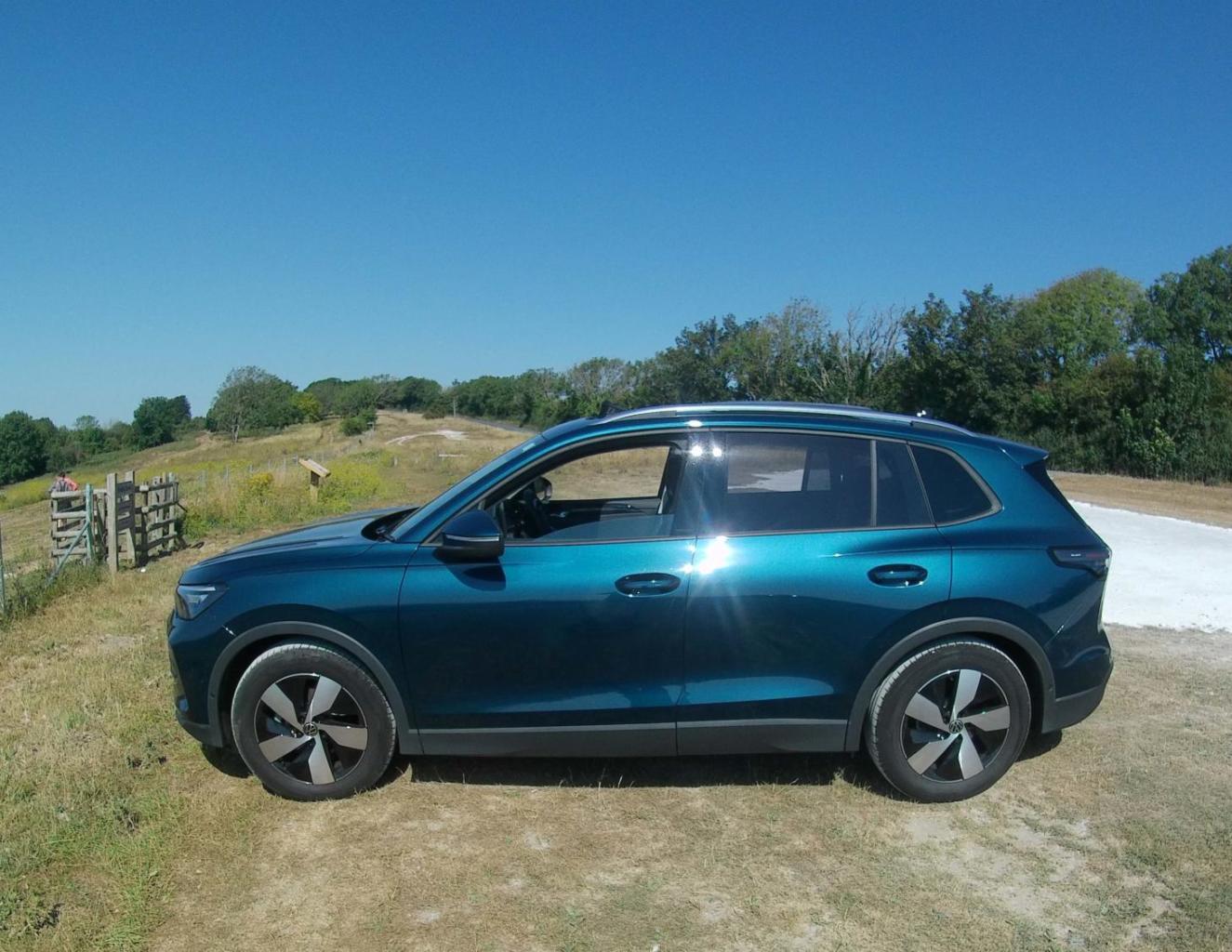
Externally, the Tiguan mild hybrid is a smart-looking, sophisticated vehicle, finished in a tasteful metallic blue. It’s a sizeable vehicle with good amounts of legroom for five occupants, and the large boot is perfect for a family’s requirements from a tip run to a break away.
I take it on the Wightlink ferry from Portsmouth to Fishbourne on the Isle of Wight, and when we return to the vehicle, we find that the only cars to have their alarms sounding on the crossing are those from the VW Group – the Audis, VWs and Skodas. They must have very sensitive alarms compared to, say, Hondas.
For me, the Tiguan is a reflection of society. It highlights when change is incorporated for the sake of it and does not bring any advantages with it. Sadly, the Tiguan feels like a large, lumbering, lethargic vehicle, well suited to our times and in need of a health check.
Facts at a glance
Volkswagen Tiguan Life 1.5 eTSI 150PS 7spd DSG
Price £42,335
0 to 60mph: 8.8secs
Top speed: 130mph
Economy: 45.6 to 47.1 mpg
CO2 emissions 135 to 141 g/km
Range: 550 miles
Watch the video at www.testdrives.biz




Add a comment