

To mark this year’s York Literature Festival, we’re turning the pages of the rich literary traditions and printing history of God’s Own County…
1. The city of York has rich, longstanding associations with printing and books. Stonegate was the epicentre of the publishing and bookselling trade, and the iconic bookshop No.35 Stonegate (operating since 1682) continues this heritage to this day.
2. Stonegate was also the site of The York Mercury, the first newspaper to be produced in the city. Thought to have been founded in 1719, the paper was acquired by famous printer Thomas Gent in 1724, running until the mid-1730s.
3. If you look closely, you can find evidence of York’s literary history all over town, such as the statue of Minerva resting on a pile of books at the corner of Minster Gates and High Petergate, and the famous statue of the pesky Printer’s Devil, located on – you guessed it – Stonegate!
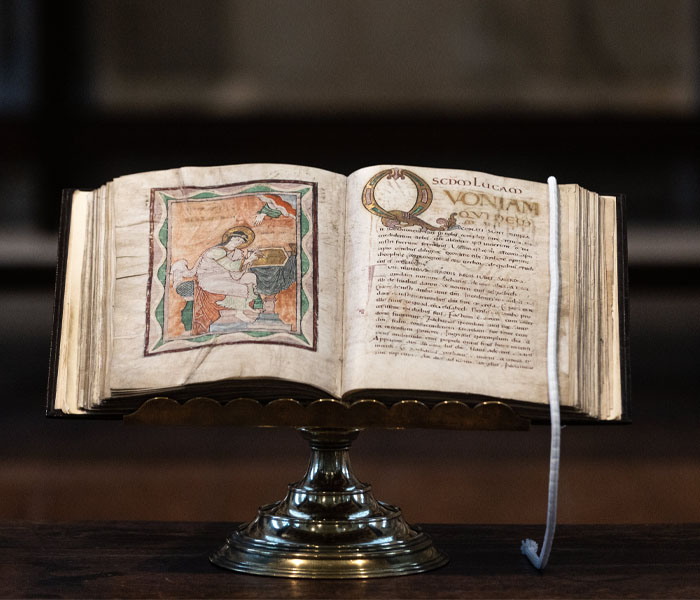
4. Thought to have been in the city since 1020, ‘The York Gospels’ is the oldest book to be found in York Minster. Its folios were made from calfskin (with a single page crafted from sheepskin), and it features the New Testament gospels. Visit www.royalsocietypublishing.org/rsos/article/4/10/170988/92995/The-York-Gospels-a-1000-year-biological to learn more.
5. Located at the bottom of Stonegate and leading towards the Minster, the street currently known as Minster Gates was another haven for bookworms, being previously known as Bookland Lane and Bookbinder’s Alley. It’s still home to unique bookshops to this day.
6. As a regular visitor to the city, Charles Dickens (aka ‘The Inimitable Boz’) is thought to have found inspiration in York’s bustling, narrow streets; in chapter 6 of ‘Nicholas Nickleby’, Dickens recounts the local legend behind York Minster’s iconic Five Sisters Window.
7. Novelist Laurence Sterne penned his first piece of fiction (‘A Political Romance’) in York, whilst working as an Anglican clergyman. The initial volumes of his best-known work, the picaresque satire ‘The Life and Opinions of Tristam Shandy, Gentleman’ were first published by Anne Ward on Stonegate, in 1759.
8. Today, York is home to one of the largest, best-established rare and antiquarian book fairs in the country, The York National Book Fair. It was first established in 1974 at the famous watering hole, the White Swan Inn.
9. The Old Swan Hotel (formerly known as the Swan Hydropathic Hotel), located in nearby Harrogate, would serve as a ‘hiding place’ for pioneering whodunnit writer Agatha Christie, who famously disappeared from public view between 3-14 December, 1926.
10. Nearby Whitby famously inspired the writing of Bram Stoker’s ‘Dracula’, the most famous Gothic horror novel of them all. Stoker would stay in Whitby in 1890, and his influence can still be found today, with attractions and events like the Whitby Dracula Trail and Whitby Goth Weekend…
Visit www. yorkliteraturefestival.co.uk to find out more about this year’s York Literature Festival 2026, which runs from 28 February throughout March.





Add a comment